
Header image: Memory Benches
Friday, Feb 2, 2026: Day 1
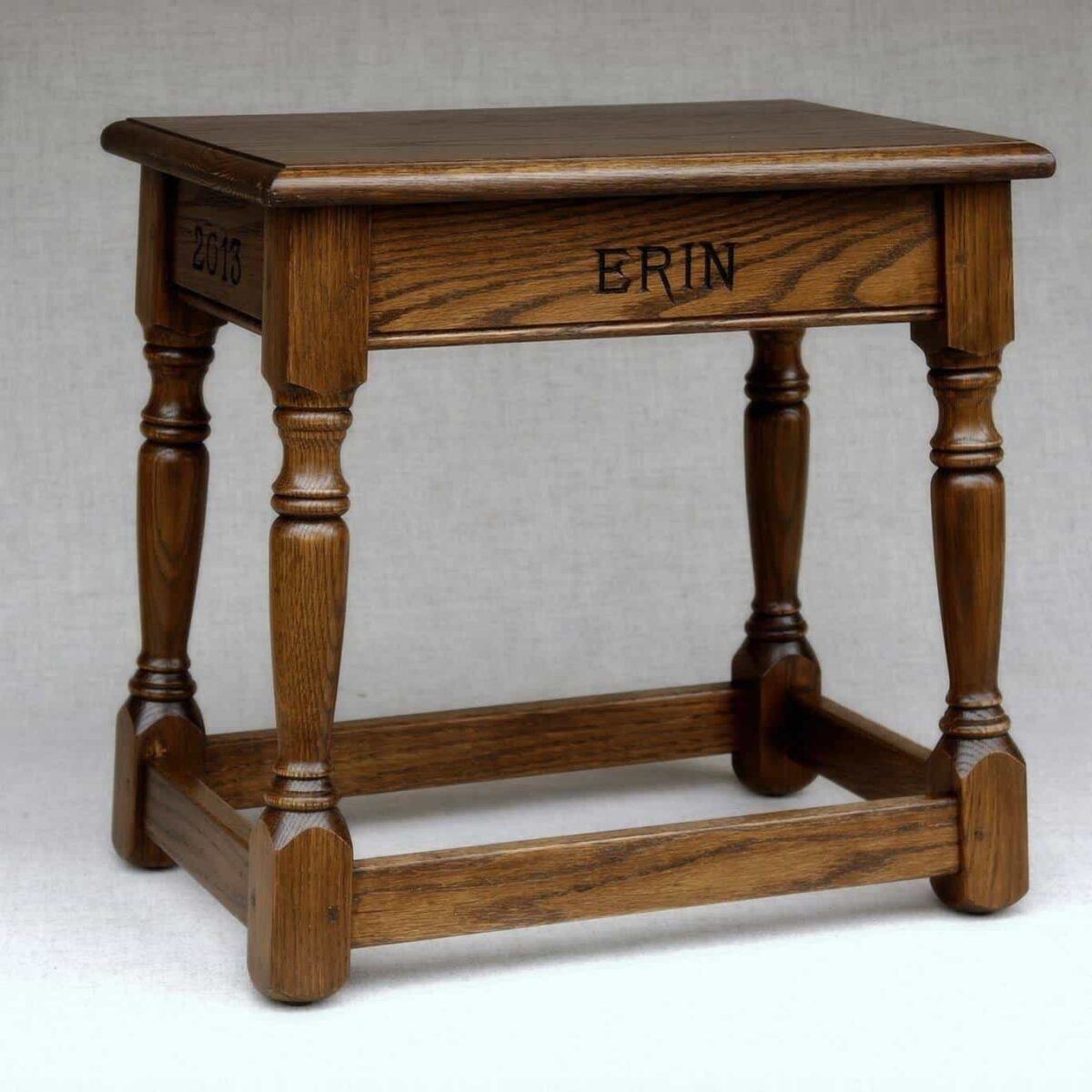
Today, while on what has become my regular Friday visit to BCIT, I had the great fortune to be invited to make a piece of furniture alongside and under the tutelage of KS. She is trained in Joinery/Cabinetmaking and her the item of furniture in question is a replica of the “wedding bench” that KS’s grandfather made many moons ago. The pic above is a good example: It’s essentially a side table with the names of the married couple carved into either side.
KS’s parents asked her to make a wedding bench for them, to continue a family tradition, and she asked me if I’d like to make my own one alongside her. I jumped at the opportunity and we got started today. I expect it will take quite a few more Fridays until we are finished but I am excited to have the opportunity to learn alongside KS and to continue to engage in more of the side conversations on teaching and learning that come up as we work.
I did some digging into the origins of the Wedding / Memory Bench. My best lead comes from Shepherd’s Cottage of Markham that states these are “A Toronto tradition since the early 1940s. Started by Ridpaths Fine Furniture.”
In 1942 Ridpaths Furniture needed a wedding gift for an employee who was getting married. At the time many gift items were in short supply, because of the war, so they decided to make their own. The result was a bench with the names of the bride and groom and their wedding date and year carved around it. They called it a Douglas Stool. After the war ended there was demand for wedding gifts and this useful and practical bench was well received by the newly married couples, now setting up their new home. There were many gifts made with the names and date engraved on it but this bench was seen to be symbolic of the wedding itself. Each of their names was carved on a long side, so, each person had their own space, their own outlook, no one came first and they had each other’s back. It was also pointed out that the two names were joined together by their date. So like a marriage, two individuals are now connected by a date. Ridpaths closed their doors in 2011 after making thousands of these wedding gifts. A gift they had invented some 70 years earlier. This tradition continues in Markham. (Source)
Mike & Debbie Reilly have been making these in Markham since 1985. Their Facebook page has a bunch of examples of what they make and the video below shows some of the process.
A message I just received from Mike/Debbie provides more context and some more leads to follow up on the historical angle
The history goes back to the Tudors. They were a common piece of furniture at the time, often carved with decoration or perhaps initials or years. The style changed with the times. In the puritan era they had no decoration. Samuel Pepys wrote in his diary, about two stools being used to support a coffin at a funeral and some people still call them coffin stools. They are also called a joint stool because they were joined together( no nails) and made by a craftsman called a joiner.
BINGO! Coffin stools
Also, from Reddit:

KS is making her bench out of alder; I am making mine out of ash. I’ll add more notes and tidy this up as I go along and connect more pieces.
╬
Issues/ideas arising:
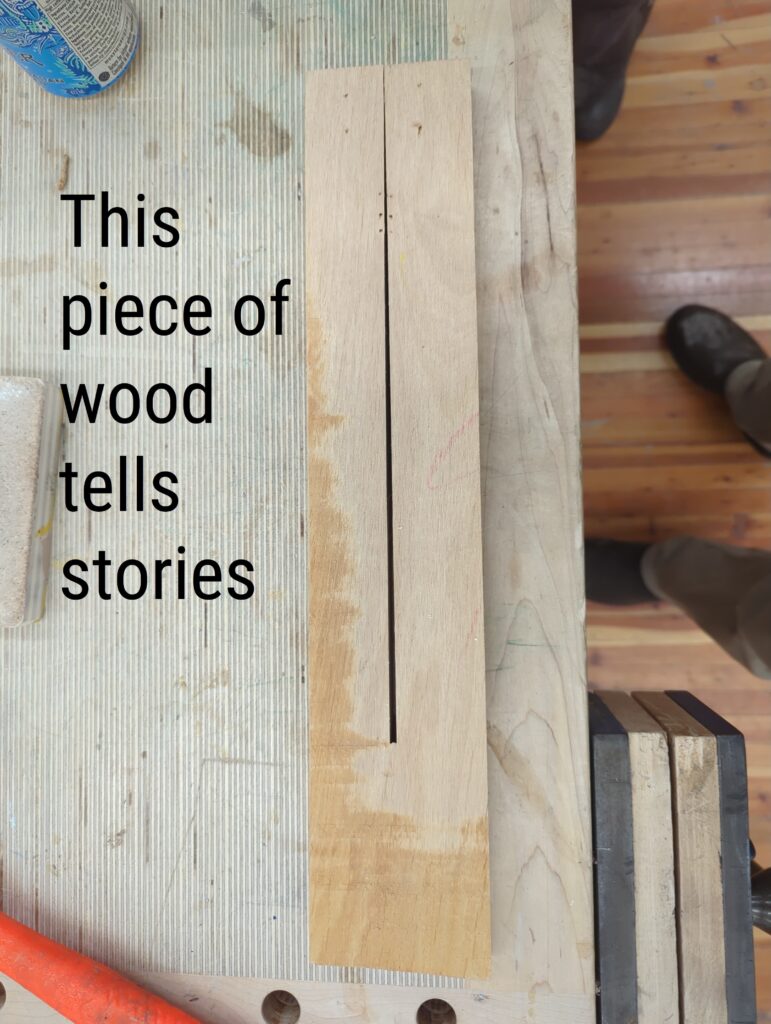
- Is the symbol customary mark on the faced side of a board an ichthys/Jesus fish?
- Perhaps a stretch, but the carpentry connection is obvious. I can’t immediately find anything online but I’m sure I’ll come back to this.
- Caverly doubts the connection. Suggests a look at “hobo symbols“
- (Oct 11) Face, Edge or End Be Sure to Make Your Mark!
https://www.plycreations.com/blog/face-edge-or-end-be-sure-to-make-your-mark
- Perhaps a stretch, but the carpentry connection is obvious. I can’t immediately find anything online but I’m sure I’ll come back to this.
- Casket bookshelf
- (June 7, 2020) This Designer Created a Bookshelf That Can Be Turned Into a Coffin After Death
https://mymodernmet.com/william-warren-shelves-of-life/https://mymodernmet.com/william-warren-shelves-of-life/
- (June 7, 2020) This Designer Created a Bookshelf That Can Be Turned Into a Coffin After Death
- The Art of Making a Hurley: Crafting the Heart of Gaelic Games [Ash is the connection here]
https://experiencegaelicgames.com/news/the-art-of-making-a-hurley/
- (Jan 5, 2026) Woodworking was WORK. What happened?
YouTube: Rex Krueger – 15 mins - Homework
- Heads Up for Safety
https://www.bctea.org/heads-up-for-safety/
- Heads Up for Safety
∞
Friday, Feb 20: Day 2
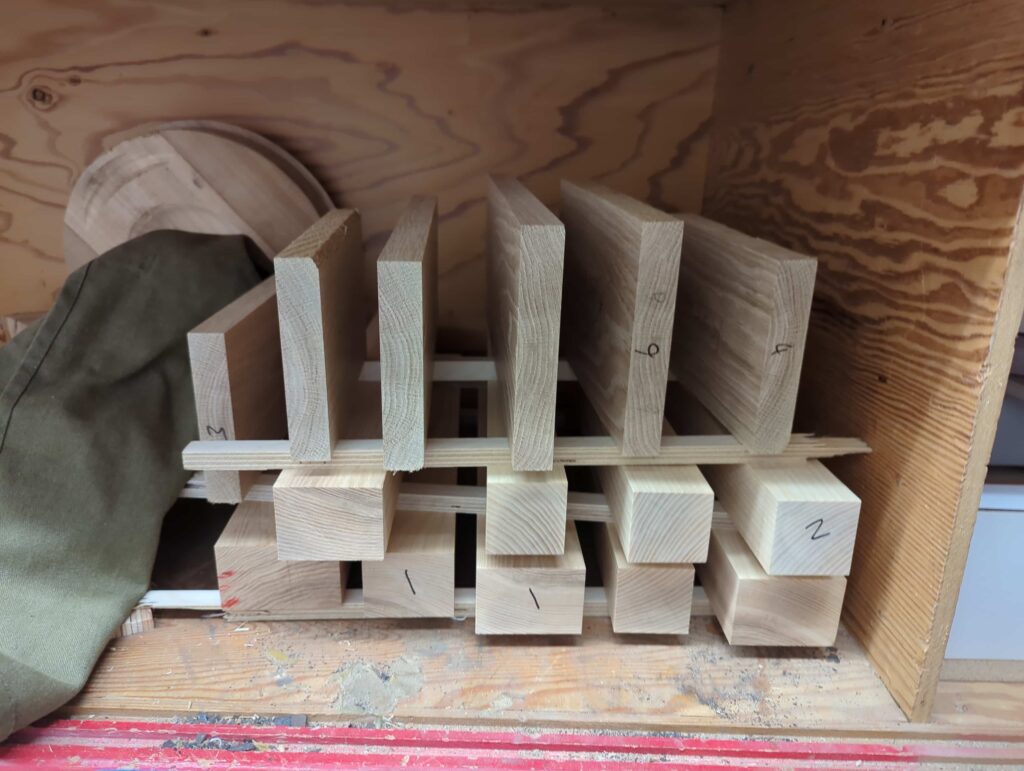
Today, KS spent about 5 hours with me, doing some work that she could have done herself in about 25 minutes. Of course, apart from the actual doing of the work, KS introduced me to the machines (jointer / plainer), how to set up and adjust them, and how to use them safely. She also answered all my questions, many of which were asked twice and some of which only ‘clicked” some time later: Such is learning.
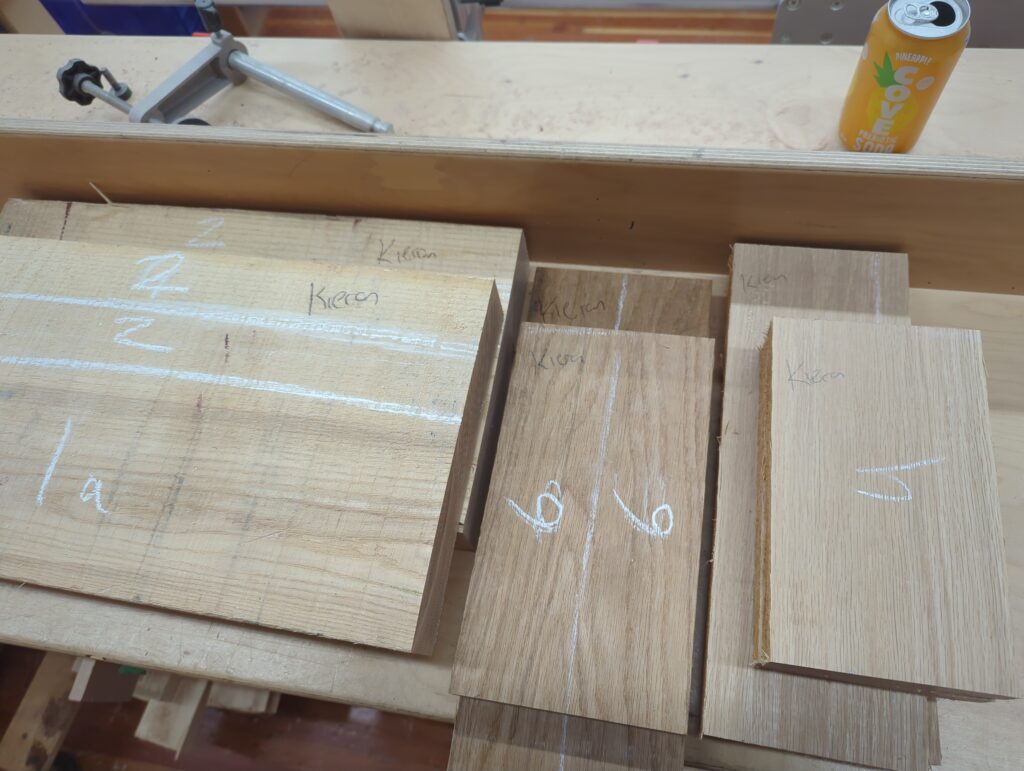
The stock we had cut two weeks ago had acclimated so we were cutting for S4S (Surfaced Four Sides). Next time, we will finish it, with precision, as we move to the next steps of the project.
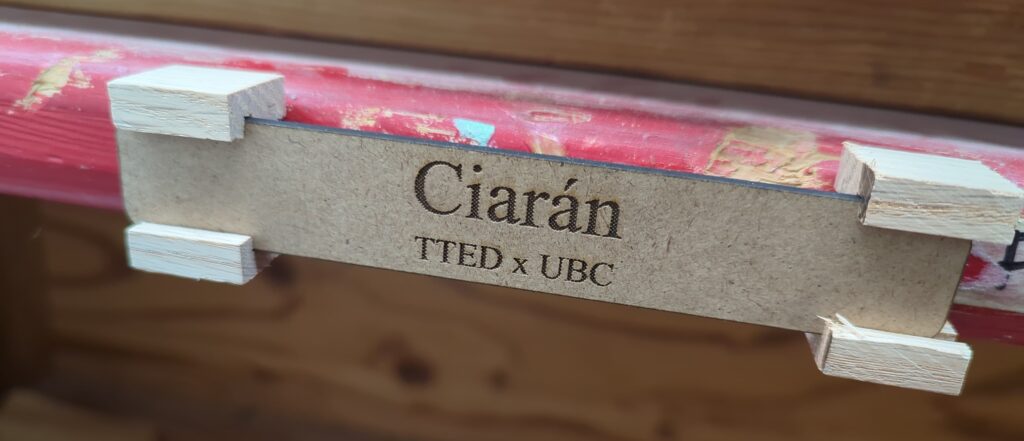
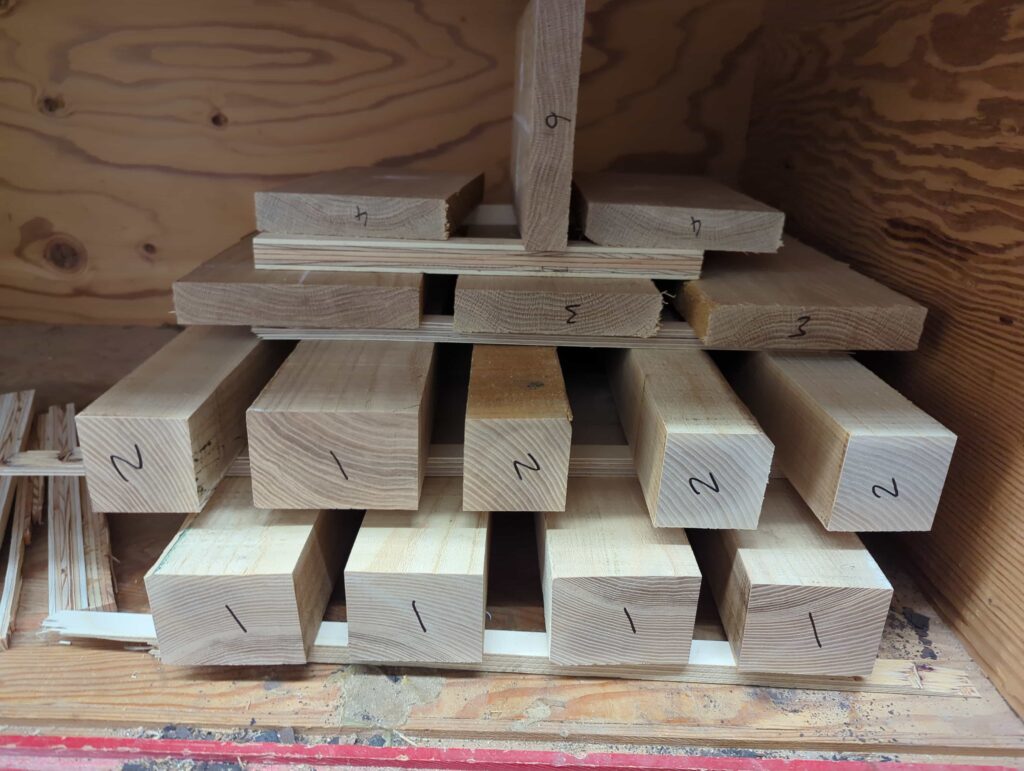
I have been given the great honor of being assigned my own cubby in the glue-up room (above). Space there is at a premium (it’s prime Vancouver real estate), so it is great to have my own space here. It also means I can take some of my other works-in-progress from behind the door in Rory’s office.
Following up on the term “coffin benches”
I interviewed people first in the west of Ireland and then my second stage of research was going to urban areas, and interviewing people, in Dublin and interviewing undertakers here. The use of furniture in the house was something new to me, I discovered some families had stools and wake tables. In the city you would have a circular dining table and when folded down – it was exactly the same size as a coffin. In the country it was more benches and stools which were used for playing games at the wake to pass the time. So that’s where the idea came from for my furniture.
– William Doherty: National College of Art and Design (Ireland)
∞
Wednesday, Mar 4: Day 3
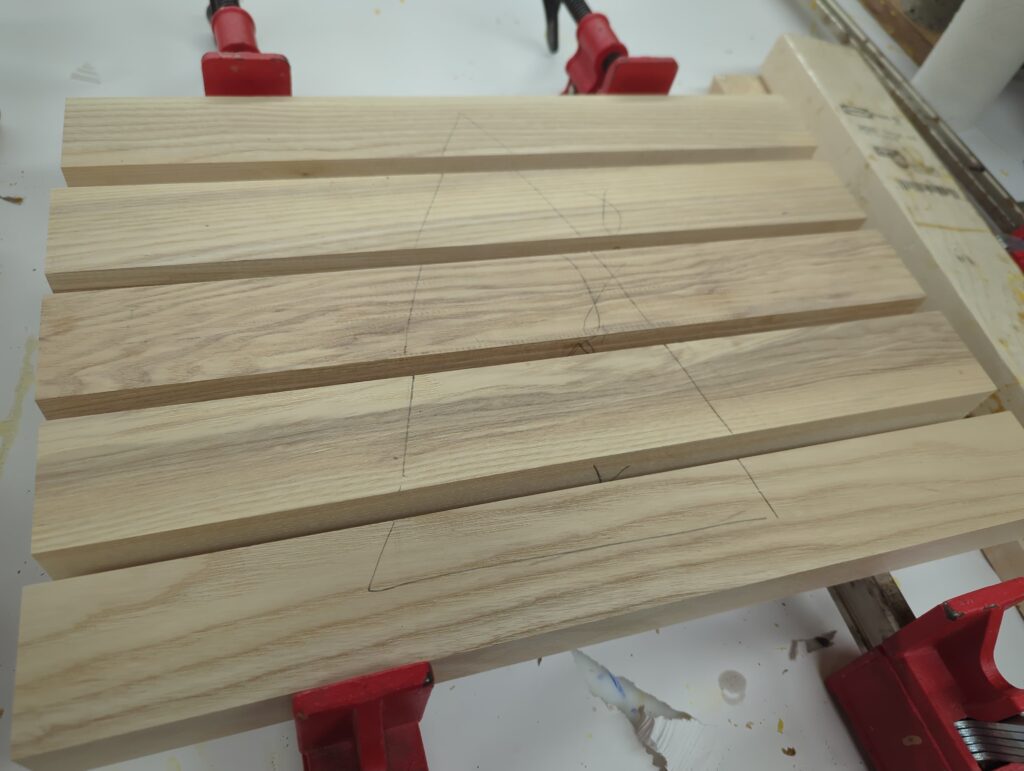
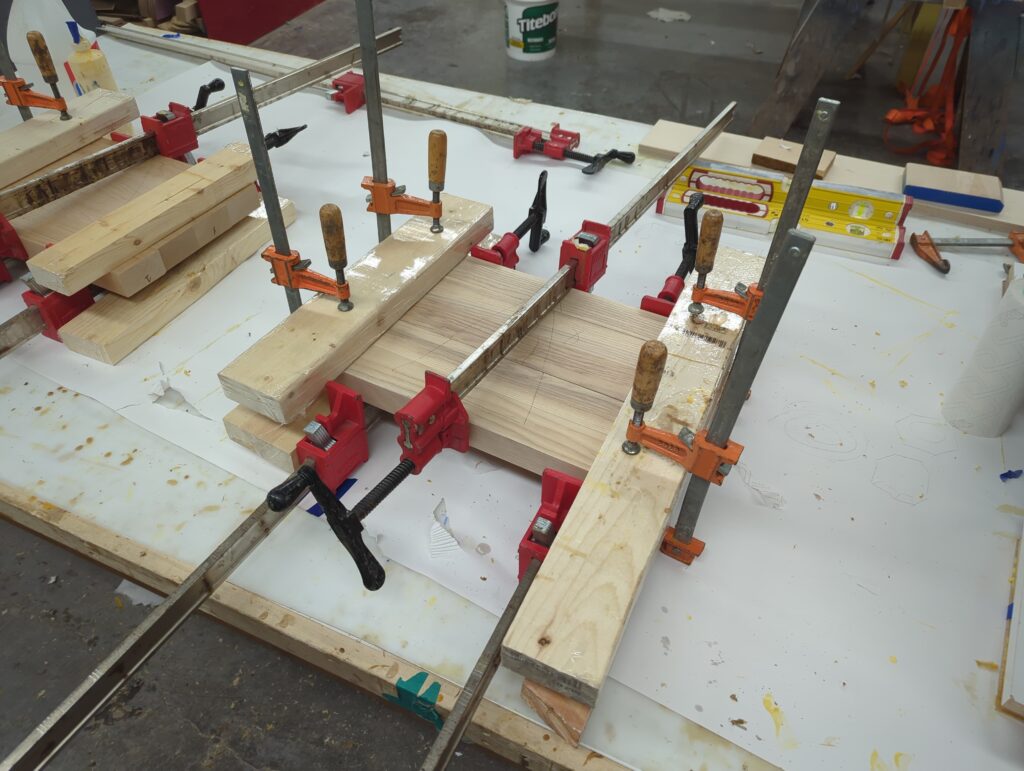
Today, KS and I refaced a few of the pieces that had acclimated into being un-parallel and ran all the pieces through the table saw to approx width.
Then it was glue’n’clamp time to laminate the pieces to form the seat of the bench. Another good day.
We took some time off in the middle so I could join the BCIT Diversity Circles session on Reframing Masculinity: An Indigenous Perspective, led by Indigenous Cultural Safety & Humility Consultant/Facilitator Harley Eagle
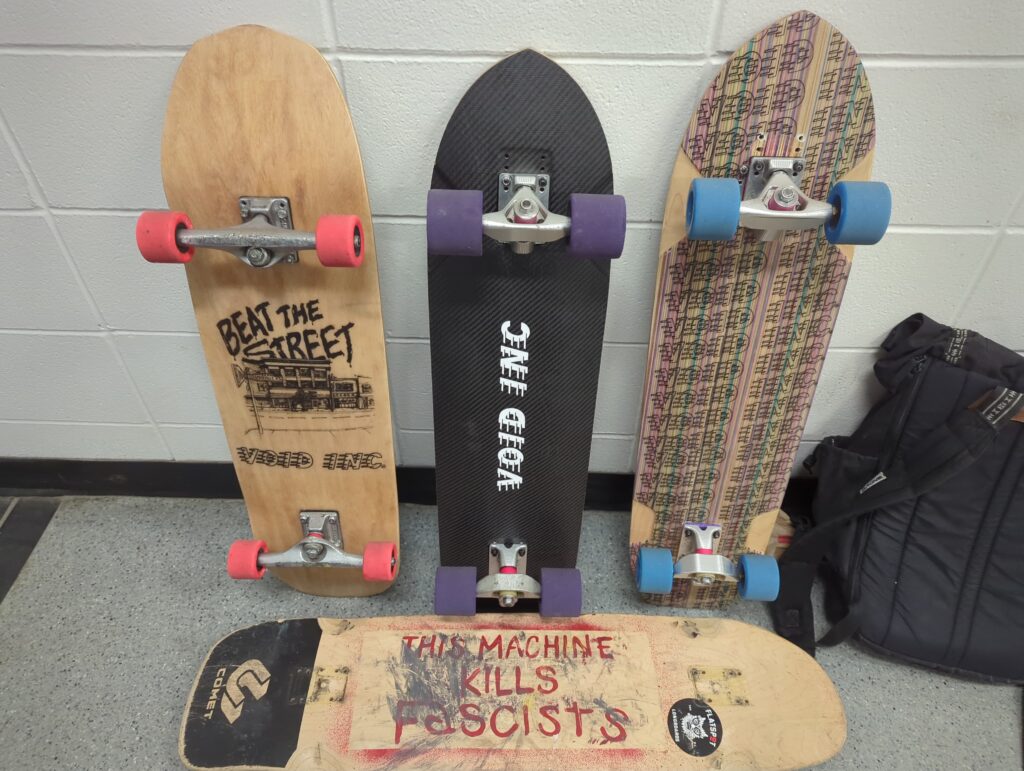
- “The idea originated from a sticker that American machinists affixed to metalworking lathes and drill presses to support the war effort.”
- A 1943 portrait of Guthrie holding his “lethal” instrument has since become one of the most recognizable images of a rare historical moment when even societies long vested in the separation of art and politics appear willing to accept what the German cultural critic Walter Benjamin saw as the necessary “politicization of art” in the face of fascist “aestheticizing of politics.”