
Most Rev. John Healy, D.D., LL.D., M.R.I.A.,
Bishop of Clonfert; Commissioner for the Publication Of the Brehon Laws; Ex-prefect of the Dunboyne Establishment, Maynooth College.
https://www.gutenberg.org/files/41073/41073-h/41073-h.htm
╬
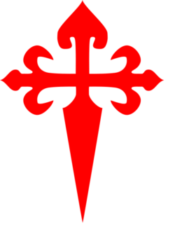
Cross of Saint James
https://en.wikipedia.org/wiki/Cross_of_Saint_James
╬
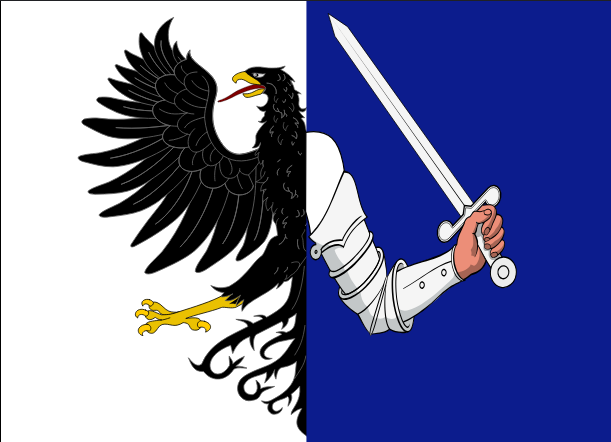
Flag of Connacht (~1651)
https://en.wikipedia.org/wiki/Coat_of_arms_of_Connacht
- [1] The image comes from the arms of the Abbey of St. James in Regensburg, Germany, a monastery founded by Irish monks in the 11th century.
- The black eagle was the emblem of the Holy Roman Empire, symbolising the Abbey’s imperial protection and high status in continental scholarship. The abbey’s original arms show an arm holding a short dagger, but here’s the twist: the dagger was deliberately shown upside down.
- Why? Because its hilt formed the Cross of St. James, patron of pilgrims. The weapon wasn’t meant as aggression, it was a devotional emblem, representing the Abbey’s spiritual mission under imperial protection.
- When the design made its way back to Ireland, the motif evolved. The dagger became a sword, the arm was made stronger and more defiant, and together they came to symbolise Connacht’s warrior lineage, likely inspired by the O’Connor kings of medieval Connacht.
Scots Monastery, Regensburg
https://en.wikipedia.org/wikiScots_Monastery,_Regensburg#Irish_period
The Scots Monastery (in German Schottenkirche, Schottenkloster or Schottenstift) is the former Benedictine Abbey of St James (Jakobskirche) in Regensburg, Germany. It was founded in the 11th century by Irish missionaries and for most of its history was in the hands of first Irish, then Scottish monks. In Middle Latin, Scotti meant Gaels, not differentiating Ireland from Scotland, so that the term Schottenstift dates from the Irish period.